APEC leaders pledge tech and trade unity
Gyeongju summit urges innovation and cooperation on climate, digital change
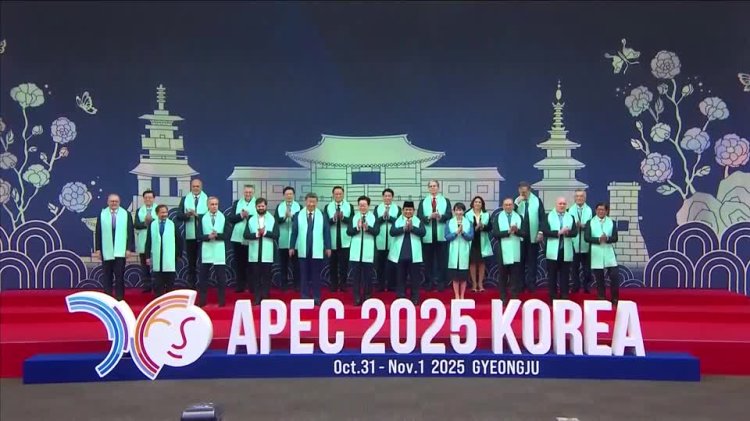
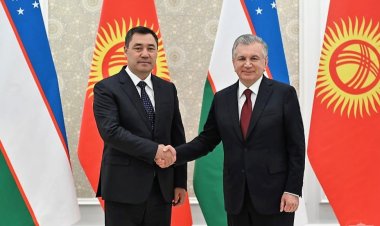
Leaders and senior officials from the 21 Asia-Pacific Economic Cooperation (APEC) member economies posed for a group photo in Gyeongju after the forum’s handover ceremony, wearing turquoise scarves inspired by the traditional Korean hanbok. South Korean President Lee Jae-myung joined counterparts and heads of international organisations, exchanging brief remarks and handshakes. Chinese President Xi Jinping announced that China will host next year’s APEC in Shenzhen.
The summit in Gyeongju convened heads of state and government representing nearly 60% of global GDP and half of world trade to pursue cooperation on trade, technology and sustainability under the theme “Building a Sustainable Tomorrow: Connect, Innovate, Prosper.” Host President Lee urged nations to “embrace innovation while protecting shared prosperity,” framing technology and climate collaboration as central priorities. Delegates focused on supply‑chain resilience, artificial intelligence, green energy and demographic pressures that threaten long‑term growth across the region.
One of the summit’s most anticipated moments was the meeting between U.S. President Donald Trump and President Xi, coming after talks in Busan that produced a partial trade truce and commitments on rare‑earth exports. Still, disagreements persisted on tariffs, data security and digital trade rules. Several leaders, including Canada’s Prime Minister Mark Carney, warned the “era of unfettered free trade is over,” urging more balanced, sustainable approaches. Japan and Australia emphasized regional stability and the need to secure critical technologies and diversify supply chains.
Seizing the platform, South Korea unveiled an “APEC AI Initiative” aimed at setting ethical standards for AI development and applying digital tools to address ageing populations and productivity shortfalls. Trade ministers worked on a joint declaration reaffirming support for open markets and climate‑friendly innovation, though differences among members raised the prospect of delays in producing a unified statement.
Security in Gyeongju was tight: thousands of police officers were deployed and airspace restrictions imposed as more than 15,000 delegates, journalists and business leaders attended. The summit concluded with a leaders’ retreat intended to map out a roadmap for inclusive growth and digital transformation through 2030. Observers said the gathering tested whether Asia‑Pacific economies can reconcile divergent interests and agree on coordinated responses to technological change and shifting geopolitical dynamics.