

Shenzhen leads China in driverless drive
Guangdong expands unmanned cars, buses and drones
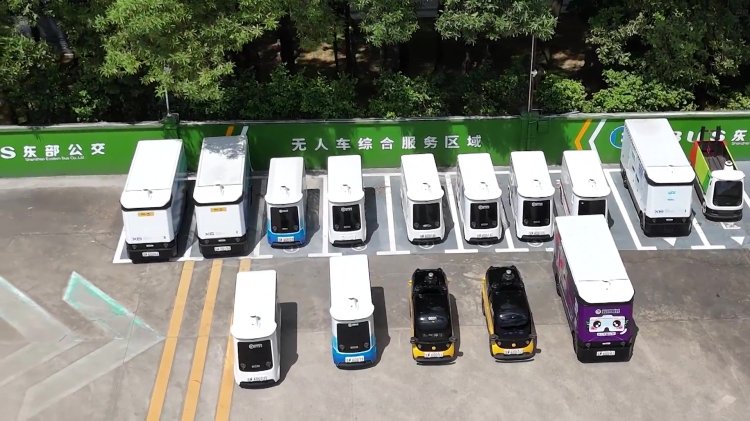
A reporter from China News Service toured Longgang District in Shenzhen, Guangdong, to witness the province’s push to become a “city of unmanned vehicles.” Longgang alone operates 82 autonomous logistics vans on 280 routes, covering more than 55,000 km. These vehicles handle a wide range of deliveries, from parcels to medical supplies. At the district’s People’s Hospital, driverless carts transport medicines, reagents, devices and test samples, streamlining internal logistics.
Automation is also reshaping waste collection. Certain streets now use unmanned garbage‑collection vehicles, reducing the manpower previously required for recycling. Bus companies are testing driverless vans for auto‑parts transport and meal delivery, further cutting labor needs.
Guangdong’s broader strategy extends beyond Longgang. Shenzhen has launched China’s first city‑wide unmanned delivery network, spanning over 30 km and ten cross‑district routes that link Longgang, Longhua, Pingshan and Bao’an. More than 300 autonomous delivery vehicles serve over 100 neighborhoods, handling up to 80,000 parcels daily and allowing residents to track shipments via mobile apps. The city is also preparing large‑scale robotaxi pilots in Qianhai New District with firms such as Pony.ai, targeting busy commercial zones, airports and exhibition centers.
Guangzhou reports over 24 million km of autonomous‑vehicle testing on public roads, involving 17 companies and covering driverless buses, logistics vans and sanitation robots. Fifty driverless buses already run on more than ten routes, supported by upgraded 5G coverage, roadside sensors and smart traffic lights that form a “vehicle‑road‑cloud” network.
Smaller cities are joining the effort. In Shantou, a WeRide S1 driverless street sweeper operates continuously at Chaoren Wharf, easing the workload for sanitation crews. The provincial government is also investing in a “low‑altitude economy,” with firms like EHang testing autonomous aerial vehicles for cargo and passenger transport. Officials aim for the sector to generate over 300 billion yuan by 2026, despite challenges in airspace management, safety regulations and three‑dimensional traffic control.
Public acceptance and safety remain debated topics. Guangdong has introduced new regulations to guide testing and commercial deployment of unmanned systems. Shenzhen was among the first Chinese cities to permit driverless cars on public roads without a safety driver, albeit under strict conditions.
Collectively, these initiatives position Guangdong as one of the world’s most advanced regions for autonomous mobility.