

U.S. and EU agree on trade deal with 15% tariff
The United States has reached a framework trade deal with Europe, announced by President Donald Trump, which aims to prevent a potential trade conflict between the two major economies. The agreement includes a 15% tariff on European Union (EU) goods entering the U.S. and commits the EU to significant purchases of U.S. energy and military equipment. While this deal provides clarity for EU companies, many in Europe view the 15% tariff as a disappointing outcome compared to their initial goal of a zero-for-zero tariff arrangement, although it is an improvement over the previously threatened 30% rate.
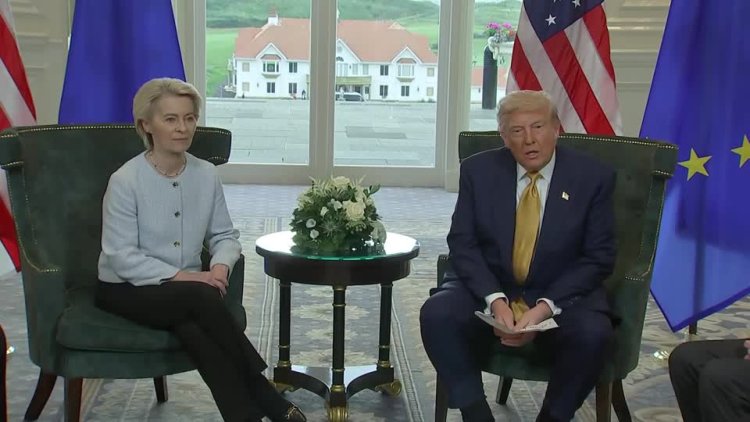
The announcement followed discussions between Trump and European Commission President Ursula von der Leyen, who sought to finalize the deal during her visit to Scotland. Trump has been focused on restructuring global trade and reducing the U.S. trade deficit, which reached $235 billion with the EU in 2024. The EU has pointed out that the U.S. surplus in services helps balance this deficit.
Under the new agreement, most EU exports to the U.S. will incur a 15% tariff, significantly lower than Trump's earlier threats. In return, the EU has pledged to purchase approximately $750 billion in U.S. energy over three years and invest $600 billion in the U.S. market. Certain high-tech sectors, including aircraft components and pharmaceuticals, will operate under a zero-for-zero tariff regime, eliminating duties on these goods. Existing 50% tariffs on steel and aluminum will remain but are expected to transition to a quota system.
While Trump hailed the deal as the "largest trade deal ever," critics argue it disproportionately benefits the U.S., shifting EU tariffs from an average of 1.5% to a flat 15%.