China’s startups unveil robotics breakthroughs
Firms debut humanoids, AI models and brain-machine tech at Wuzhen summit
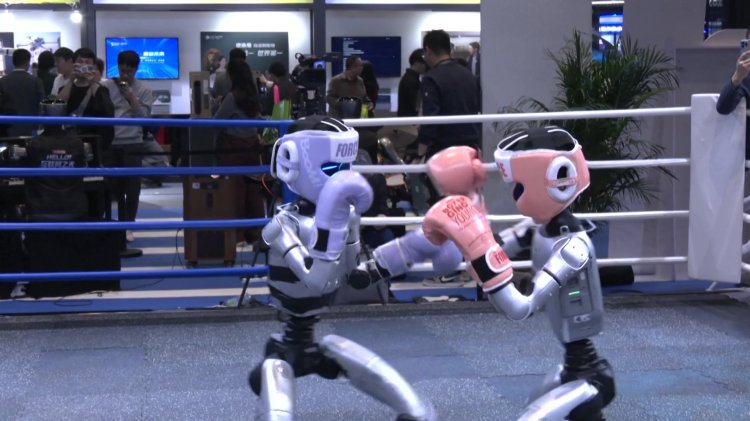
Chinese tech startups showcased major advances in robotics and artificial intelligence at the World Internet Conference Wuzhen Summit, unveiling products that blur the line between laboratory prototypes and practical applications. A cluster of six Hangzhou-based firms—dubbed the “Six Little Dragons” and including Unitree Robotics, BrainCo, DEEP Robotics, Manycore Tech, Game Science and DeepSeek—drew particular attention for breakthroughs across humanoid robots, brain‑machine interfaces, spatial AI and gaming technology.
Unitree’s humanoids demonstrated increasing agility, performing complex sequences such as consecutive backflips, highlighting progress toward consumer and service uses. DEEP Robotics unveiled a four‑legged robot dog capable of autonomous navigation, obstacle avoidance and speeds up to four metres per second, pitched for inspections in substations, factories and chemical plants without continuous human remote control. BrainCo presented a bionic hand that can be operated remotely via brain‑machine interface technology, promising precise, dexterous manipulation for hazardous environments. Manycore Tech introduced a spatial large language model that lets robots interpret natural‑language commands within a virtual room representation—enabling tasks like routing from a washing machine to a bed to fold a quilt. DeepSeek revealed an AI model that compresses text input using visual perception, while Game Science previewed its anticipated game “Black Myth: Zhong Kui.”
Beyond the Wuzhen exhibits, several startups reported progress toward commercial deployment. Shanghai’s AgiBot uses tele‑operation training and reinforcement learning to perform manufacturing‑line tasks; Mech‑Mind Robotics began operations in Xiong’an with AI‑driven robotic manufacturing solutions; Unitree’s expanding product line has drawn international interest. Observers attribute the momentum to coordinated national policy, investment and talent initiatives that accelerate hardware‑software co‑development in generative AI and robotics.
Industry analysts see immediate implications for manufacturing—where AI‑trained robots increasingly handle complex, formerly human tasks—and for consumer and service sectors, as robots gain realistic expressions, autonomous power management and interactive behaviours. Market forecasts project rapid expansion of China’s robotics industry, potentially making it a dominant force in global robot deployment.
Challenges persist, including intense competition among startups, chip and supply‑chain constraints, and dual‑use concerns over military or surveillance applications. Commercial viability must keep pace with technological demonstrations.