Thai police clash with Cambodians at border
Tear gas and rubber bullets fired as protest over barbed wire escalates
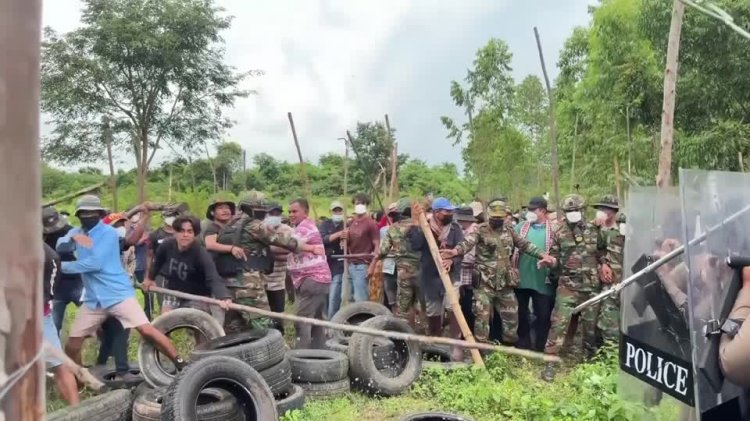
Thai police used tear gas, rubber bullets and a long‑range acoustic device against Cambodian civilians who tried to remove barbed‑wire barriers in a disputed border area. The clash occurred near the settlement Thailand calls Ban Nong Ya Kaew in Sa Kaeo province, while Cambodia identifies it as Prey Chan in Banteay Meanchey province. About 200 Cambodian protesters approached the Thai‑installed fence, demanding its removal; Thai riot police ordered them to retreat and, after negotiations failed, fired non‑lethal munitions. Cambodian demonstrators responded with wooden sticks, rocks and slingshots.
This is the most serious escalation since the July cease‑fire that ended a five‑day deadly confrontation. Cambodian authorities reported at least 28 injuries, including several Buddhist monks; Thailand confirmed five soldiers wounded. Both sides blame the other for provocation: Cambodia condemns “excessive force” and says the cease‑fire was breached, while Thailand argues the crowd crossed into Thai territory and deliberately tried to tear down the barriers.
An ASEAN Interim Observer Team entered the area earlier that day to monitor tensions but withdrew after the violence erupted, citing safety concerns. No fatalities have been confirmed. The flare‑up threatens the fragile peace established after the July truce and revives concerns over a border dispute rooted in colonial‑era maps and a 1962 International Court of Justice ruling that left several sections ambiguous.
The dispute stems from differing interpretations of those colonial boundaries. Thailand asserts sovereignty over the fence‑lined tract; Cambodia insists it lies within its Prey Chan village. The 1962 ICJ decision delineated portions of the frontier but left gaps, allowing the present flashpoint to persist.
In July, a five‑day clash along the same border left dozens dead before ASEAN mediators brokered a cease‑fire requiring mutual withdrawal, joint monitoring and a pledge not to build unilateral barriers. Despite that, Thailand installed barbed‑wire fences in early September, prompting local officials in Banteay Meanchey to organise a protest.
Thai statements stress that riot police first attempted dialogue, issuing verbal warnings before using crowd‑control tools. They claim protesters ignored orders, continued to dismantle the wire and hurled projectiles, necessitating a measured response. Cambodian officials allege Thai forces opened fire without sufficient warning, violating the cease‑fire and endangering civilians, including religious figures.