Shenzhou-20 crew completes first spacewalk
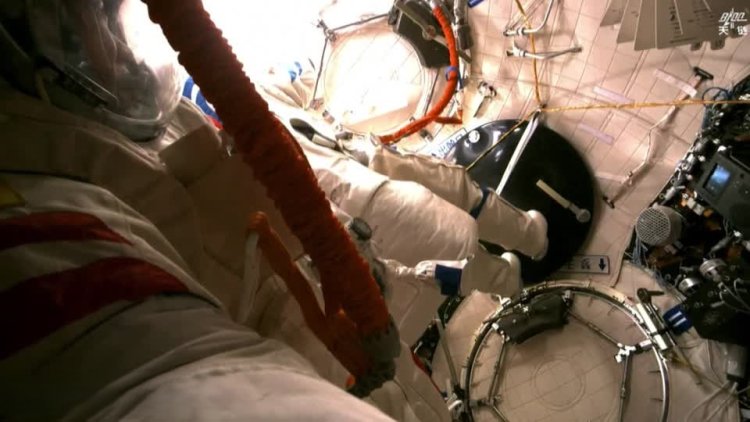
The Shenzhou-20 crew successfully completed their first spacewalk, marking a significant achievement for China's Tiangong space station. The extravehicular activity (EVA) took place and was facilitated by meticulous planning and effective coordination among the astronauts and ground teams, according to the China Manned Space Agency (CMSA).
Astronauts Chen Dong and Chen Zhongrui conducted the EVA, while Wang Jie assisted from inside the station. The mission began with Chen Dong opening the hatch of the Tianhe core module's node cabin and exiting the space station. He then attached himself to the robotic arm to receive equipment from Chen Zhongrui, who exited the cabin shortly after.
This EVA is notable as it is the first since the space station entered its application and development phase on December 31, 2022. The decision to exit through the node cabin was made to optimize the efficiency of both the robotic arm and the astronauts' operations, as explained by engineer Zhang Qiao.
During the approximately eight-hour spacewalk, the astronauts completed several tasks, including the installation of space debris protection devices and inspections of extravehicular equipment. They returned to the Tianhe core module and closed the hatch at 16:49, successfully concluding the first round of EVAs.
This mission set a record for the shortest interval between a crew's arrival in orbit and their first spacewalk since the completion of the space station.
Chen Dong conducted his second spacewalk, having previously completed one two years ago, while Chen Zhongrui performed his first EVA. The crew, which arrived at the Tiangong space station on April 25, has been engaged in various tasks, including maintenance, inspections, and medical exercises. They are scheduled to conduct 59 space science experiments and technology tests, along with additional EVAs and cargo transfers during their time in orbit.