Soyuz crew lands safely in Kazakhstan
The Soyuz MS-27 crew returns safely after eight months
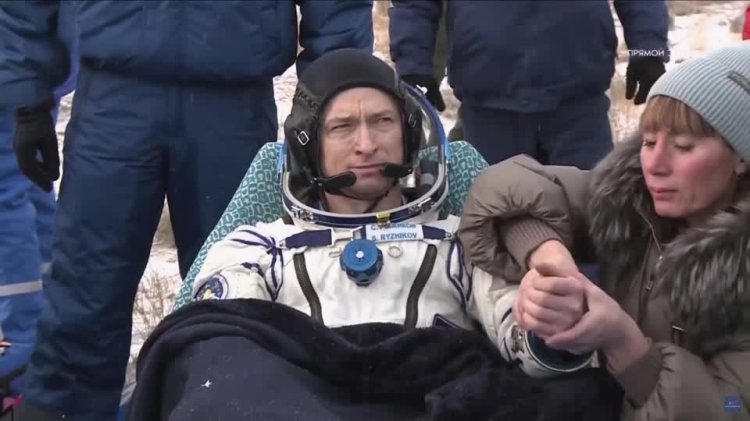
A Soyuz MS-27 spacecraft carrying Russian cosmonauts Sergei Ryzhikov and Alexei Zubritsky and NASA astronaut Jonathan Kim safely returned to Earth, Russia’s Roscosmos space agency said. Video released by the agency showed Ryzhikov and Kim being helped from the capsule and undergoing post-landing medical checks. The spacecraft touched down near the Kazakh city of Zhezkazgan after a controlled descent described by Roscosmos as smooth and nominal.
The crew completed an eight-month mission aboard the International Space Station, conducting experiments across biology, materials science and Earth observation, NASA said. Recovery teams reached the landing site quickly to assist the astronauts as they began rehabilitation and debriefings following an extended period in microgravity.
Officials from Roscosmos and NASA emphasized the return as evidence that practical cooperation in space continues despite strained geopolitical relations on the ground. Both agencies highlighted that joint ISS operations remain driven by safety protocols, scientific priorities and long-established technical arrangements that enable multinational crews to live and work together in orbit.
During their stay, the trio participated in dozens of experiments aimed at advancing life-support systems, improving radiation shielding and studying human physiological adaptation to long-duration spaceflight—research considered crucial for planning future deep-space missions. The data and crew observations gathered in orbit will be processed as part of ongoing efforts to refine countermeasures for muscle and bone loss, cognitive performance under isolation, and other health risks associated with extended missions.
The successful landing also served a logistical role for ISS operations. With crew rotation and launch schedules carefully managed, the safe return of Soyuz MS-27 clears capacity for upcoming missions tasked with maintaining continuous habitation and research aboard the station. Space agencies noted that the orderly turnover of personnel and cargo is essential to sustain scientific output and prepare for planned activities, including technology demonstrations and international experiments.
Recovery and medical teams carried out standard post-flight assessments on site before the astronauts were moved to medical facilities for further evaluation and rehabilitation. Debriefings with mission control and scientists will follow, focusing on experiment results, spacecraft performance and crew health metrics gathered during the mission.