

U.S. signs trade deals with four Asian nations
Agreements target supply chains and ease tariffs with key partners
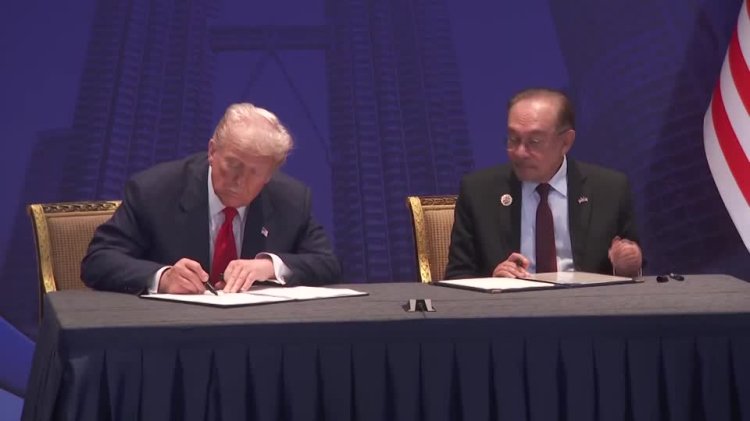
The U.S. signed a series of trade and critical minerals agreements with four Southeast Asian countries, aiming to ease trade imbalances and secure supply chains as China tightens its grip on rare earth exports.
President Donald Trump, who was in Kuala Lumpur for the ASEAN summit, inked reciprocal trade deals with Malaysia and Cambodia, and a framework agreement with Thailand to tackle tariff and non-tariff barriers.
Under the deals, the U.S. will keep a 19% tariff on exports from the three countries, with some goods set to enjoy zero tariffs.
Washington also announced a similar deal with Vietnam, which has been levied with a tariff rate of 20% on its exports to the US.
Trump signed separate deals with Malaysia and Thailand to strengthen cooperation on critical minerals.
Two deals were fully executed (with Malaysia and Cambodia) and framework agreements were reached with Thailand and Vietnam. The White House said the pacts keep a general tariff of 19% for Malaysia, Cambodia and Thailand (20% for Vietnam), while allowing zero tariffs on selected goods; in return the four countries agreed to remove trade barriers and grant preferential access to U.S. exports.
Separately, Washington signed cooperation deals with Malaysia and Thailand on critical minerals. Malaysia pledged not to impose export bans or quotas on critical minerals or rare earths bound for the United States, though officials did not clarify whether that commitment covers raw ores, processed materials or both. The move comes as China—by far the leading producer of rare earths—has tightened export controls on refining technologies, prompting global manufacturers to seek alternative sources for materials used in chips, electric vehicles and defence systems. Malaysia is estimated to hold about 17.8 million tonnes of rare earth deposits but currently bans raw exports to encourage domestic downstream development.
Under the agreements’ provisions, Thailand agreed to eliminate tariffs on roughly 99% of goods and relax foreign-ownership limits in its telecommunications sector while committing to substantial U.S. purchases in areas such as aircraft and energy. Cambodia opened wider access to U.S. trade, investment screening cooperation and digital trade standards. U.S. officials framed the package as part of a broader strategy to diversify supply chains away from China’s dominance and to strengthen U.S. economic and strategic ties in Southeast Asia.