China’s reusable rocket hits orbit on debut
First-stage recovery fails after landing burn anomaly
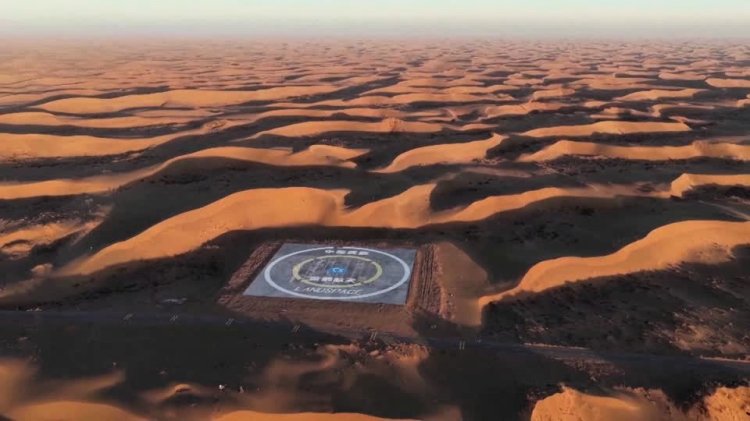
A Chinese reusable carrier rocket completed its maiden flight, achieving stage separation and orbital insertion before an attempted recovery of the first-stage booster ended in failure due to anomalous combustion during the landing phase. After ignition and liftoff, the first and second stages separated roughly 130 seconds into flight; the second stage continued the mission while the first-stage booster began its return. Recovery operations proceeded as planned until the final descent, when combustion irregularities prevented a soft touchdown on the pad. Investigators have opened an inquiry into the precise cause.
In a Beijing interview, the rocket’s designer, Dai, said that early failures are part of the development process, noting SpaceX’s own history of unsuccessful landings before it achieved routine recovery. He argued that large-scale, failure-tolerant flight testing—facilitated by deep private financing—has enabled rapid iteration abroad, and he welcomed recent Chinese capital-market reforms that broaden funding access for hard-tech firms.
The flight followed policy shifts on the STAR Market, which in June 2025 expanded listing standards to include strategic sectors such as commercial aerospace, artificial intelligence and the low-altitude economy, opening financing channels for experimental hard-tech companies that have not yet reached profitability. Analysts and executives say the STAR Market’s looser profit requirements and focus on technological potential have eased funding bottlenecks for aerospace firms, enabling investments in R&D, production scaling and supply-chain upgrades. Companies in satellite manufacturing, propulsion, avionics and related fields have reportedly used new capital to expand capacity, shorten development cycles and recruit technical talent.
Officials frame the market-led support as part of a broader push for technological self-reliance amid geopolitical tensions and export controls, with capital-market reform complementing industrial policy to foster globally competitive aerospace firms. Observers caution that technical risks remain high and that companies face pressure to convert investment into commercial results while maintaining transparency and governance to sustain investor confidence.
Despite the failed landing, project leaders described the mission as a valuable data-gathering exercise. The mission adds to China’s accelerating activity in launch vehicles and satellite internet initiatives, underscoring a fast-moving race to develop reusable rocketry and broader space capabilities.