

Trump arrives in UK for state visit
Tech deal worth £31 billion tops agenda with Starmer
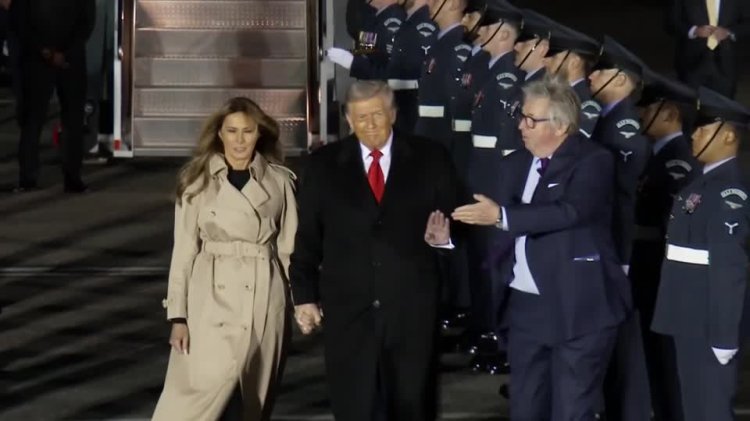
U.S. President Donald Trump and First Lady Melania touched down in Britain for a two‑day state visit, the second formal trip of his presidency. Their aircraft landed at London Stansted, where they were received by British Foreign Secretary Yvette Cooper and Viscount Henry Hood, representing King Charles III. After a brief helicopter ride they were taken to Winfield House, the U.S. ambassador’s official residence, where they will spend the night.
The agenda centers on cementing a “Tech Prosperity Deal” valued at roughly £31 billion (about US$42 billion). Major American firms have pledged sizable investments: Microsoft will allocate around $30 billion to expand cloud and AI infrastructure and to help build the nation’s largest AI supercomputer in north‑east London; Google will commit close to $7 billion for a new data centre and AI research; Nvidia plans to deploy 120,000 advanced chips across the country. The pact also calls for joint work on AI applications in healthcare, the expansion of quantum‑computing capabilities, and the acceleration of civil‑nuclear projects. Prime Minister Keir Starmer hopes the deal will portray Britain as a hub for light‑touch regulation and attract further overseas capital, bolstering a growth agenda that has come under pressure.
Diplomatically, Trump will be hosted by King Charles III at Windsor Castle, where a state banquet is scheduled. The visit is framed as a renewal of the “special relationship” between the United States and the United Kingdom, with trade, technology and security cooperation high on the list of discussion points.
The trip has not been without controversy. Protesters in London and Windsor have staged demonstrations against Trump’s policies and his presence in the UK. A notable stunt involved projecting images of Trump alongside the late Jeffrey Epstein onto the walls of Windsor Castle; four participants were arrested for the unauthorized display. Authorities described the act as a breach of public order, underscoring the polarising effect the president continues to have among the British public.
Despite the dissent, British officials stress the strategic importance of the visit. Starmer and his cabinet aim to use the high‑profile meetings to deepen economic ties and present a united front on issues such as climate policy and security cooperation. The combination of lavish ceremony, multi‑billion‑dollar tech commitments and street‑level protests encapsulates the complex dynamics of the transatlantic partnership at this moment.