Scientists create fast-growing synthetic lichens
Lab system turns CO2 into fuels and chemicals
Scientists at Imperial College London are engineering fast-growing "synthetic lichens" that use carbon dioxide and light to help make useful chemicals. The lab-grown systems pair cyanobacteria - photosynthetic bacteria - with yeast: the cyanobacteria make sugars, and the yeast can turn those sugars into fuels, pharmaceuticals and food ingredients.
In nature, lichens are hardy partnerships between fungi and photosynthetic algae or cyanobacteria, often seen as crusty or leafy growths on rocks, trees and soil.
Synthetic lichens, developed by Professor Rodrigo Ledesma-Amaro and his team at Imperial College London, are inspired by the natural symbiosis between fungi and photosynthetic partners such as algae or cyanobacteria, but grow much quicker than natural lichens.
The work could also have implications beyond Earth, with researchers exploring how microbial systems might one day help produce materials, food or fuels during space missions.
"There's a huge interest from many space agencies now in how we're going to manufacture the food, the chemicals, the fuels we need in space," Professor Rodrigo Ledesma-Amaro said in a lab in west London. The system uses cyanobacteria to convert carbon dioxide and light into sugars, which engineered yeast can then use to produce compounds such as biofuels, chemicals, pharmaceuticals and food ingredients.
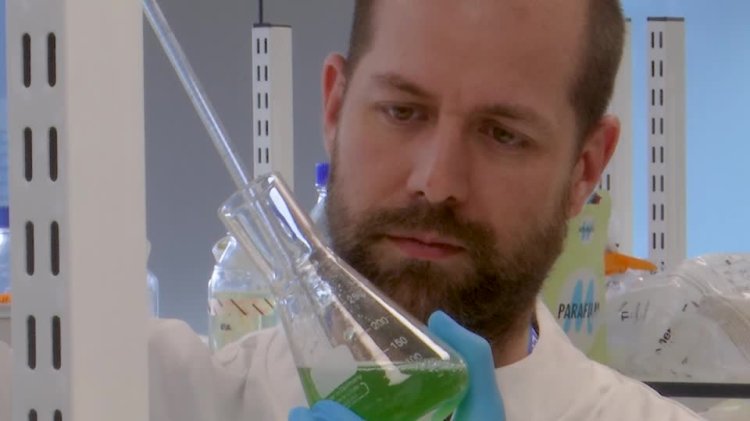
“In this flask it has the cyanobacteria which gives the green light, but you also have the fungus," Ledesma-Amaro said.
"They are growing together, which means the cyanobacteria is fixing the CO2 light and is producing a sugar and the yeast, the fungus can use that sugar to make other things and we can engineer that metabolism to make that final product to be biofuels, chemicals, pharmaceuticals, food ingredients or whatever we want it to be. But we can make it sustainably thanks to this community,” he said.
Separate research has proposed using lichen-like microbial systems for future space construction, including concepts for binding Martian regolith into building materials, although such applications remain at an early experimental or conceptual stage.