Cobra Gold drills expand in Thailand
U.S. and Asian forces stage major amphibious exercise
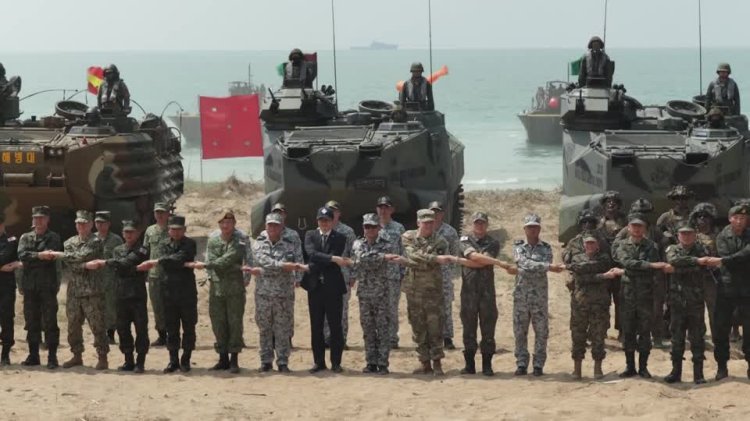
South Korea and Singapore joined Thailand and the United States in large-scale amphibious drills off Thailand’s eastern seaboard as part of this year’s Cobra Gold exercise. The beach maneuvers opened with a simulated airstrike and coordinated amphibious landings using assault vehicles, fast landing craft and rotary-wing aircraft, followed by inland advances to secure mock objectives and repeated clashes between attacking and defending forces.
Now in its 45th year, Cobra Gold has expanded into a heavy training cycle that integrates a full-scale field training component; more than 8,000 personnel from 30 countries are participating. Command centers from the four lead nations operated jointly, sharing real-time intelligence and coordinating fire support, surveillance and logistics to test interoperability under demanding conditions.
Planners said the drills emphasized communications compatibility, logistics integration, and rapid engineering and medical responses. Engineers practiced runway repair while field medical teams rehearsed casualty evacuation; separate scenarios simulated disaster relief operations such as distributing emergency supplies and setting up temporary shelters after a mock coastal storm. Officials described these humanitarian modules as essential given the region’s frequent severe weather events.
South Korea contributed amphibious reconnaissance elements, and Singapore deployed naval vessels and maritime security support units. Thai and U.S. commanders highlighted long-standing Bangkok–Washington defense ties as the exercise’s backbone, noting growing participation from regional partners to bolster collective preparedness. Analysts characterized the multinational drills as part of a broader uptick in joint training across the Indo-Pacific amid shifting regional security dynamics, while military leaders reiterated the exercise’s defensive focus and its aim to enhance stability.
The multinational sequence culminated in a large-scale amphibious demonstration observed by senior defense officials, underscoring commitments to sustained cooperation and operational capability among participating forces. The exercise, which began earlier this week, is scheduled to continue into early March.